Tuesday, December 30, 2014

One Word 2015 - Present


I've found it a bit more of a challenge to sit down and write lately. It is not that I do not have anything to say but more that I feel that there is so much to do that the time to sit and write is no longer there. I click almost daily on my blog and mean to write but then get sidetracked by something else. 

It is taking some time to find a new balance to my life since finishing my masters in April. I didn't realize until it wasn't there anymore how all-consuming it became in the course of the three years. I needed time to recharge but I also needed time to process so much of what we had learned in that time.

Life is beginning to settle in to a new way of being both personally and professionally. I am becoming more comfortable with what my job has evolved in to. I am finding time again to be the parent that I want to be to Mikey. And I am also finding time for me. 

I have, for some time, been clear in what I believe in and what I want to stand for but only in the past months do I feel that I can take the complexity of it all and find and articulate the simplicity of what it means right now. 

I'm not really one for resolutions but am big on reflections. There are points in any year that invite reflection and I find this time of year to be one of those points for me... not because we magically change the number behind the month on the calendar but because it comes right after a relaxing time of reconnecting with family and friends and right before my son's birthday (January 3). It's a time to reflect and reconnect to others but also to myself.  Instead of resolutions, it makes sense to me to think about the word that I want to guide my life for right now and this year "present" just seemed the right word. 

Change is wonderful and exciting and it does energize me but you can get so caught up in what the dream is for the future that you forget to stop and recognize the parts of the dream that you are living right now. Blogging, for me, has always been part of being in the moment as it is provides the opportunity to reflect and so it is my hope that 2015 will bring with it a bit more regular posts from me :).

Thursday, September 25, 2014

Together We Are Stronger


"The 'allegory of the long spoons' teaches us that when we struggle to feed only ourselves, everyone goes hungry. But when we focus on our neighbour’s hunger, we discover there are ways to feed everyone."

Weaknesses (spoons that are too long to reach our mouths) can inhibit our daily functioning if we think only in terms of trying to feed ourselves with what we currently individually have in our hands.  If we step outside the box though and consider other strategies and other ways to use the resources that we collectively have, we can find ways that we can all be fed. When we remove students whose spoons are too long for them to feed themselves from their natural communities, we also remove all the solutions and stabilizing factors that exist within that collective community... which affects all members of the community.

Wednesday, August 13, 2014

The Mystery at Camp ALEC - Students and Teachers Seeing Themselves as Thinkers - Part 2


Note that this post is a further expansion on my earlier post outlining the Mystery at Camp ALEC.  The experience that we had at Camp ALEC has gotten me thinking a lot about inference and how language and communication development impact the ability to gain skills in inference. 

"Inference is the mental process by which we reach a conclusion based on a specific evidence. Inferences are the stock and trade of detectives examining clues, of doctors diagnosing diseases, and of car mechanics repairing engine problems. We infer motives, purpose, and intentions."(http://www.criticalreading.com/inference_process.htm)

Inference requires reading the ideas that are behind words. Both listening and reading should be active, reflective, problem solving processes. Listening and reading require simultaneously taking in language (words) and constructing meaning about what those words mean in a given context.

Why was it that these campers, who were all proficient communicators and who all had access to unlimited vocabulary through speech or their devices, were able to engage in a process of inquiry in to "who done it" around this poster? Could a camper who did not have the autonomy that comes with access to an unlimited number of words have engaged in this process?  How did the understanding of language lead these campers to solving the mystery?  

In this process, we needed to take what was "literally" presented to us and use that as a starting point for our detective work. Early in the process, the campers tried to link what was being said to who might say those things and to explain why they might say them.  Throughout the process, they found hints or had hints point out in the language that wrapped itself around the experience. They keyed in to the ideas on the poster trying to think through if it  might be someone who had a potbelly and hair on his knuckles that would write such a thing, thinking through the sarcastic tone and the people know who might use that tone with their words, trying to remember the pronoun (we) that was used when they believed they had figured it out...etc. 

Understanding more than what is literally on the paper and going beyond just laughing at and moving on, required access to language (words), understanding of the meaning of words and phrases that were being used, understanding the social conventions that wrapped around the way we used both oral and written language through the process, and understanding the context that all these words were sitting in the middle of.  Even their final solution to get their last suspect to confess came down to the fact that they had spent some time with him during the investigation and believed that taking a round-about approach of smothering him with hugs and coffee until he confessed might work better than straight out asking had. 


If I were given a "do-over" of this mystery experience at Camp ALEC, I think it would have been good to give it a bit more of an formal organizational structure by using a K-W-H-L chart.  Although we went through all of these phases, it would have been nice to have this all more formally organized so that we could reference back to it as we went through the process.  It would have also set the stage a bit better for wrapping up the experience. 

I included the "teachers seeing themselves as thinker" part in title of this series of post for a reason. We came in to each of these days with what we thought would be interesting and useful literacy activities for the campers we were working with but in the middle of their excitement about this mystery, we had to scrap our plans and go with where they were leading us.  At one point when we tried to return to the activities we had planned, one student interrupted the lesson and asked when we were going to get back to the mystery... and then typed in to her AAC device... "I'm in to that."

I'm in to that... These are perhaps the most powerful words that can ever come from a learners "mouth". 

I came away understanding more deeply that if we want our students to engage in the active in-the-moment meaning making that is required for them to become a proficient reader, we might have to be willing to engage in the same process in the middle of the learning experiences that we are co-creating with our students.  It come down to defining our purpose.  If we know what we are trying to accomplish we can be open to the possibility of taking different paths to get there.

Our goal with these campers was to have fun (it was camp after all) and to gather the information for the informal literacy assessment that we were doing with these students throughout the week. We needed to gain understanding around these students print processing skills, their language and reading comprehension skills, their word attack skills, and their writing skills.  We could have done this in a million different ways.  Doing it this way meant that we didn't have to worry about motivating the students because they were doing that part themselves. We could then focus on engaging with them as they displayed the skills we were trying to assess in the middle of the mystery.

It didn't end with this mystery. In our work room, we ended up having campers who were reading of listening to mysteries to find language that would reveal clues, we had students who were creating clues for others to find the mystery word they were thinking of, we had students who came to understand revision through thinking of themselves as a detective looking for ways to add more necessary information to their writing.  The potential around it is only limited to the length of time that the theme would remain a motivating factor to the campers (and the limited time we had with the campers).  Did we capitalize on all the learning potential of this experience?  No. We did not. But because of this experience, the next time a student-motivated learning opportunity presents itself, we will have more to draw from and capitalize a bit more on the potential.  It was about being a community of learners.  Perhaps this was part of the beauty of merging the literal role of being a student (taking the course) and being a teacher (working with the campers).


Student engagement is a challenge for us as  teachers... particularly when we put time and energy in to planning learning experiences that we believe will be interesting and engaging for students.  If they don't engage, we sometimes want to respond by trying to make them engage. As teachers we are constantly thinking and responding to what is going on with our students. We understand the importance of focused "on-task behaviour" (aka engagement) and we want our students to learn. It's why we teach.  We know that if students are not engaged with the work they are doing, there isn't really going to be much chance of authentic learning. We sometimes even define students who are motivated by what we have designed/planned as being students who "want to learn" and those who are not motivated as "not wanting to learn". Sometimes in the process of wanting to ensure engagement in learning, we go down another path and decide that the student simply doesn't have the capacity to get anything out of what we are doing in our classrooms. We focus on the outward actions (behaviors)... the things we can see... the tangible results they can give us... and we end up putting our energy into the product rather than the process.

Sometimes when we are learning things... like the process and thinking and language involved in inference... we might not have a nice clean product at the end.  It might simply be that we are able to have a conversation that allows us to fill in that last line of the KWHL chart... and then maybe someday when a lesson is being done on inference, background knowledge can be activated as a result of the experience that took place at an earlier time.  

There are many questions worth considering. What in this can be applied to classroom where there are 20 to 30 students? Are there kids who actually don't want to learn? If there are, what would cause that? Are there kids who really not able to learn in the context of the classroom?  Do all kids need to be learning the same thing? Perhaps most important, when we are challenged by a lack of motivation... Are we aiming to increase thinking, engagement and learning or are we aiming to decrease or eliminate non-engaged or distracting "behaviour"? Is there a difference? Can we actually force kids to learn? 

Tuesday, August 12, 2014

More Thoughts from Camp ALEC - Language Based Literacy Skills


I was introduced to the "Whole to Part" literacy framework during the first course that I took from Karen Erickson and David Koppenhaver a couple of years ago. When things have time to stew and you have a variety of experiences with what yo have learned, a different level of understanding starts to emerge. I think that part of this is because some of this process involves unlearning some of the things you already "know". 

We have traditionally associated early literacy success with alphabetic and sight word knowledge and as children enter school we look to support their reading development through phonics, spelling and decoding instruction. Many of us remember doing endless workbook pages that reflect this. 

The role that oral language plays in literacy development is often given less explicit focus in early literacy learning. We expect children to master "the basics" before we tackle oral language, vocabulary, sentence structure or comprehension. 

We are more aware now that for students to develop literacy skills, we need to pay explicit attention to both print-based literacy skills (alphabet, phonics, spelling, decoding...etc.) and language-based literacy skills. 

Print-based literacy skills include alphabetic letter-sound knowledge, phonological awareness (the ability to sound out words), sight word knowledge, and phonics knowledge.  Developing these skills leads to a student who will be able to spell and decode single words. These are obviously important skills to develop in the journey to literacy but they are only a very small piece of the literacy puzzle. 

Language-based literacy skills include vocabulary, semantics, sentence structure, grammar, oral language (narrative skills), sequencing, organizing, and comprehension. The development of these skills lead to being able to express oneself in writing and read a variety of text with comprehension.

 
Print-based and language-based literacy skills fit in the areas of Word Identification and Listening Comprehension respectively in Cunningham's Whole to Part Model of Reading Comprehension (graphic above). Having low language skills does not prevent a student from learning how to do the mechanical act of reading. It will, however, impact one's ability to interpret, predict, reason or infer information from text. 

I've heard the statement made by many teachers that up to grade 2 or 3 students "learn to read" and then after that they "read to learn". This statement implies that the definitions of "reading" and "decoding" are not all that different. It also implies that one must be able to read to a certain level before one begins to work on literacy.  It also means that when a child is struggling to read in the early grades, we simply assume that it is as a result of lagging print-based literacy skills. A quick search of reading programs for struggling readers reveals the steps that we can take to get a child reading...


I'm not arguing that a student's struggle to learn to read might be a result of lagging print based literacy skills but working with students who have language and communication delays or impairments has made it even more clear that the reason a student is not making gains in reading skills may be related to something other than these print-based literacy skills that we so often globally fall back on with struggling readers. 

For students with complex communication needs, we need to pay particular attention to language based literacy skills and we can't wait until they have acquired the ability "to read" before we start focusing our efforts on developing these skills. We need to embed and connect communication with text through shared reading experiences very early on. We need to ensure that in the process of reading books with a student we are connecting what is in the book to their world and possibly even to their way of processing the world.  We need to find ways to naturally embed pointing out the text structures that will be needed as a student moves from emergent to conventional literacy. We need to speak to the student about the text using the mode of communication we expect them to speak to us with about the text so that some day they can follow our model and be able to actively engage with text.  We need to ensure that "reading" is far more than memorizing meaningless, disconnected words and completing endless workbook pages.  Reading connected text with a student offers us many opportunities to work on reading, language, and communication skills. We need to pay attention to words in all three frames - in text, connected to meaning, and used for social purposes - to move along the literacy continuum. Social interaction (communication) and text are the sources that we can draw language from to make connection and meaning (which leads to comprehension). 

I have not ignored the bottom part of the Whole to Part visual.  Print Processing (what we loosely refer to as "fluency") is another obvious potential area of struggle for a student who has complex communication needs. Developing inner speech and projecting prosody are skills that must be learned through modeling and interaction.

The bottom line is simply that rather than starting by breaking apart and teaching each part one by one in sequence, we need to take a comprehensive approach to literacy and communication learning.  These skills sit along a continuum and what we are aiming for is movement along that continuum.  Starting by knowing the whole and working on the whole then positions us to look at the parts and figure out which part might need more attention at any given time to ensure that students keep moving along that continuum.

Monday, August 11, 2014

Coming Full Circle: Reflecting on Camp ALEC

It has been a week now since I have been home from a ten-day trip to Philadelphia to be a part of Camp ALEC. I am still challenged to put in to words a reflection of the camp. I'm sure it is going to take more than one post when all is said and done.

Just to give a big of background... Tina Moreno, one of the two ladies that made this camp happen, explained the camp perfectly in her blog post yesterday:
This was the first Camp ALEC and the first camp of its kind offered in the United States. Together, we gathered 15 campers and 14 educators, speech-language pathologists and school administrators from the U.S. and Canada at Variety Club Camp and Developmental Center in Norristown, PA for a week of reading and writing assessment and interventions–plus a typical summer camp experience.  Each camper received a total of 17.5 hours of individual and small group assessment and instruction throughout the week.  The goals of Camp ALEC included building the skills of the adults who participated and determining how the campers... can be supported in further developing their reading and writing skills during the coming school year.  At the conclusion of camp, parents had an opportunity to have a conference with their child’s educator,  as well as Karen and David, and left with a report detailing the results of their informal reading and writing assessment and instructional recommendations.  Our hope is that parents will share those recommendations with teachers so that they can implement evidence-based instructional strategies that will ensure greater progress in school. (http://voices4all.wordpress.com/2014/08/11/what-i-learned-from-camp/)
In June 2011, I attended the kick off to the Literacy for All community of practice in Alberta. It was the first time I was exposed to the Whole to Part framework and to the resource  Children with Disabilities: Reading and Writing the Four Blocks Way. In August 2011, Linda Burkhart came to our area and did a two-day PODD (Pragmatic Organizational Dynamic Display) workshop.  The combination of being a part of this community of practice and gaining a deeper understanding of language and communication through Linda Burkhart's workshop and the fact that we were trying to figure out how to create more inclusive programs for students with complex communication needs in our division projected me down a path of exploration related to language/communication, literacy, inclusion and empowerment. 

In May of 2012, I flew to Toronto and attended a week long intensive Litearcy in AAC course taught by from Karen Erickson and David Koppenhaver. Although I learned much about literacy during this camp, the context that I was in the middle of in regards to being in the beginning stages of a Masters program in Inclusive Education and Neuroscience, our changing focus for the students that I had been teaching in a self-contained classroom and this immersion in information about language/communication and literacy, drove me to start thinking more deeply about learning more generally rather than just focusing in on all the amazing literacy and communication content.


It was becoming clear to me that although I had been teaching for almost 20 years at this point, I had never really taken the time to time to define or understand learning. I had thought more about the content I was trying to pour in to students then designing and facilitating exploration and discovery. It was actually only as I made the shift from general to special education that I started to see the difference between training/teaching and learning.

Sadly, this is probably because in special education we may have gotten trapped in believing that learning is rigidly linear, that learning with accommodation is not "real learning", that people with intellectual disabilities learn differently than those without (i.e. need everything broken down in to small pieces), and/or that it is more important for people with intellectual disabilities be drilled through "life skills" programs than to learn curriculum-driven academics. Rather than focusing on the function of what is meant to be learned, we focus on the broken apart steps/skills and/or the content  and we conclude there is nothing that a student with an intellectual disability could get out of it. We don't recognize the opportunities that exist if we shift to focusing on function of what is happening in the learning experience. We want immediate tangible results so rather than engaging in the sometimes slow and frustrating process of finding ways to break down barriers to curriculum-driven learning, we fall back on a reductionist behaviour training approach and end up trapping these students in a world that will be hard to ever expand because expanding works inside-out rather than outside-in. 

In the middle of everything that I was learning and experiencing, the question of how we shift the paradigm and start thinking about learning from the inside out instead of the outside in for and with this population of students emerged. It seemed there were a million separate pieces to answer... that maybe I the answer would never be one that could be clearly articulated because it was just too complex.
Training is often a passive process and is rooted in compliance. It is often a one-size-fits-all process. In education we like to train because the result of training is behaviour or simple memorization and we can objectively measure behaviour and memorization. We also like to train because we view it as an efficient process as we can "reach" a whole bunch of students at once. Training is an outside-in process. It is driven by those doing the training. Training results in putting our effort and resources in to managing and directing other human beings. The realm of training is limited... particularly to those who need support or accommodation to engage in the process of learning. 

Learning is about developing and empowering people from the inside out. Learning is about the individual... but it also about the collective as learning is social and interactive process. There is a recognition that each person will learn something different from an experience because each person comes to the experience with their own unique background. Learning is messy. Learning can be noisy and chaotic. Learning can be frustrating. Learning might not result in a final product. We ultimately cannot actual control other people's learning. We can only create the conditions for it and support it. Learning is about design. Learning results in putting our energy and resources in to design and support and the growing of other human beings as individuals. The realm of learning is unlimited as long as one has the facilitated freedom and the literacy and communication skills that are critical to the learning process.

I have much to write about from this past week at Camp ALEC but I'm starting with the fact that this feeling of upset... of cognitive dissonance... of all of this being too big to manage or do anything about or to articulate... that I have been feeling since I sat in that first meeting for the Literacy for All Community of Practice three years ago is starting to subside to a manageable level. I am beginning to see the path through the forest. This camp allowed me to work directly with kids who were developing (or had developed) strong language/communication and literacy skills. I could clearly see how this is a starting point for all the other things that are part of the forest. These kids were empowered and driven and full of life... and the life they were full of was very much their own. Their futures were not limited to what others had decided for them even though they relied on others for care-related needs.

At the end of the week I was sitting at dinner with one of the campers and the same lady (Tina) whose blog I linked to above. This camper had known Tina for years.  Tina had a son who was attending the camp who was close in age to this camper.  This young lady was explaining to Tina how she needed to step back and let her son be independent of her at camp.  She stated that he is a young man and he needs to be able to make decisions and function on his own without his mother's interference.  I was able to get to know Tina's son through the week as he was one of the campers and she clearly did not need this lecture.  Her son was an amazing and independent young man.  This conversation was more one that this young lady needed so that she could consolidate the empowering experience she had during her first whole week on her own.  She said it so passionately. She clearly was not just reciting rhetoric.  She knew this as a result of consolidating her personal experiences.  This ability to articulate thoughts like these comes from focusing on authentic language and literacy learning.  It is not just about the words that are coming out... It is about the fact that she would be able to expand on and defend what she is saying because she clearly understood and owned it. She had made her own personal connections rather than just reciting what had been dumped in to her.

This past May I completed my Capstone project for my Masters program.  At the time I was trying to answer the question of how we create cohesive and continuous inclusive programs for students with complex needs.  When I was done writing the paper I mostly just felt frustrated.  I felt that, although there was a lot of great content in the paper, it was still too big and too scattered and too overwhelming to figure how to move all of the theory in the paper in to practice in reality.  I could not see the path in the forest... it was all still trees and underbrush. 

If I were to write the paper now, after spending this time at Camp ALEC, I would narrow it down to focusing in on building solid communication and literacy learning opportunities because it is now clear to me that everything else that was in the paper will expands out from there for these students.  If we get that piece right with them, they will have the skills and understanding needed to make the other pieces right themselves.

It amazes me how dynamic and non-linear (and exciting) the process of learning and understanding can be. The experience of these past three years has helped me to more deeply understand how what we key in to and process and integrate at any given time is extremely dependent on the background that we bring to learning.  Each time we are exposed to new ideas we will see something different because we come to them from a different starting point than the last time.

Sunday, August 10, 2014

The Mystery at Camp ALEC - Students and Teachers Seeing Themselves as Thinkers - Part 1


I will start by just telling the story of what unfolded with the group of students that we were working with at Camp ALEC. Over the next couple of days I will share some thoughts related to the story...

On Tuesday (Day 2) of Camp ALEC the group we were working with began working on a writing project that began by examining Shel Silverstein's If You Want to Marry Me.  Before reading the poem, we generate a list titled If you want to be my boyfriend... Our plan for that day was to make a comparison between our list and the list included in the poem.  We were thinking that we would revisit the same text the next day and use it a model for writing (a mentor text). We were going to have students define what they felt various people in their life should do in their lives.


It seemed an innocent enough learning activity... but the next morning we came in to the room that we were doing our literacy sessions in and found a new poster on the wall...


When the campers arrived and saw the poster we began the day by wondering who might possibly have broken into our word room and posted the poster over ours.  The other group of campers that was working in our room joined in our pondering and before we knew it, we were immersed in "a mystery" and statements like "this room is on lock down" and "we need writing samples from all of the potential suspects" were being thrown around.  The Mystery of Camp ALEC had begun.

That day we did a lot of thinking and writing related to how we could figure out who did it as well as what we would do once we figured out who it was. We focused both on possible clues as well as investing through having conversations. We thought through what "interrogation" questions might help us in finding out more information. We recognized very early on that just asking someone if they did it wouldn't really get us any closer to solving the mystery.

We left camp that day not yet having solved the mystery and we decided we would revisit it the next day and think about what our next step was...

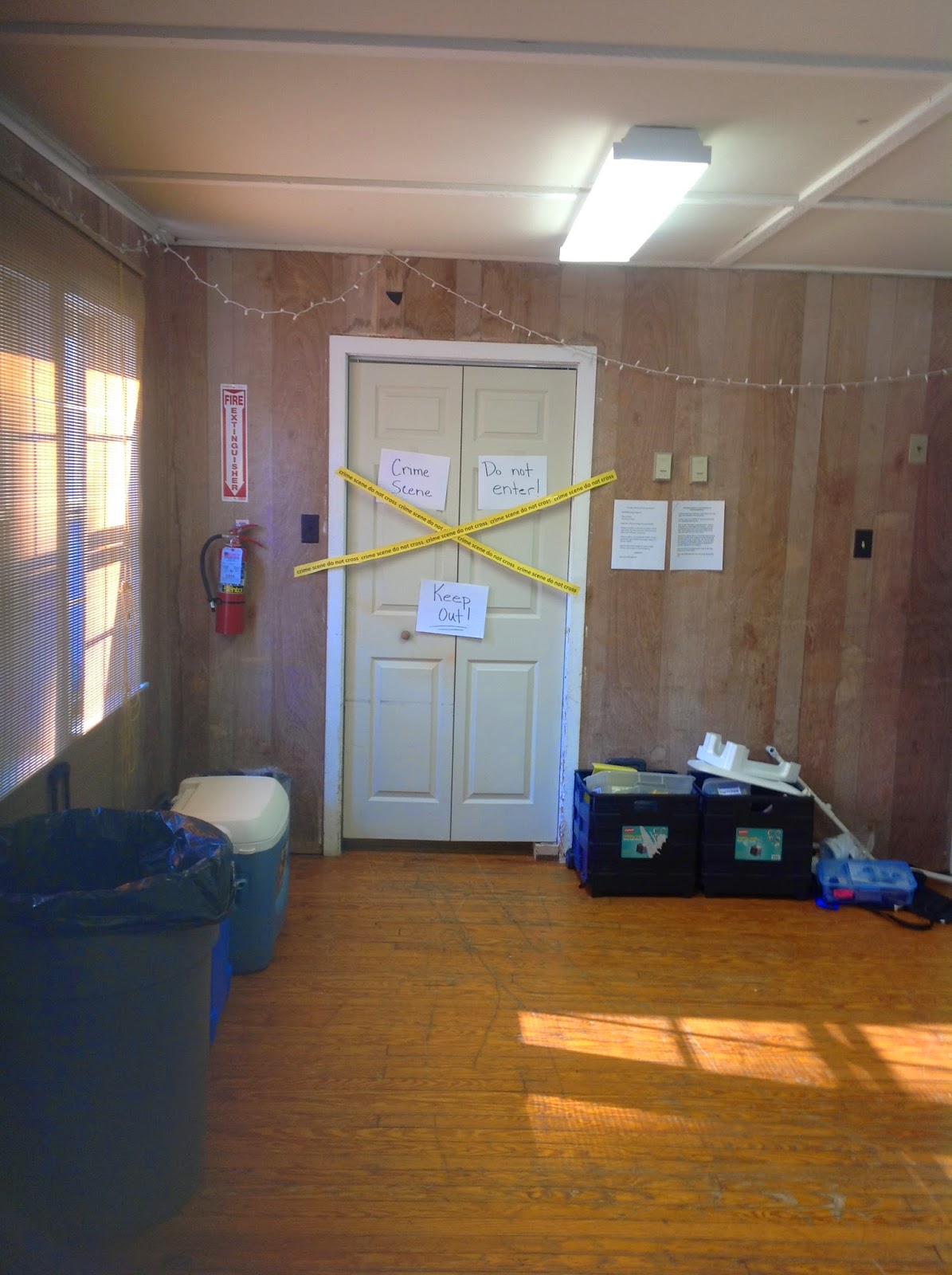
When we arrived (the literacy counselors) arrived at camp the next morning, this is what the entrance to our work room looked like...


We had to wait until the campers arrived before we could go in as we were informed that it was the campers themselves who had done this and not the "mystery people" who had put up the poster the day before. Once they arrived, there was much giggling and excitement as we went in to find what they had done. This is what we found...


After some giggling and wondering, we returned back to trying to solve the mystery of the day before. At this point, one of the campers piped up and told us that Karen (one of the instructors at the camp) had "slipped her lips" and told them she was involved in the poster we had come in to the day before. The campers called her and called on this. Apparently when they were being hands for the campers the night before and were asked to put the poster up, the question of where was asked and they said where and Karen responded with a clarifying question of "Oh do you want us to put it up over the poster we put up." All the campers picked up on it and they thought the mystery was solved but when they called Karen on it that morning she pointed out that she had used a pronoun they needed to think about. When they remembered her using the word "we" they needed to then figure out who the other person was. They decided it had to be other the instructor (someone they had suspected right from when they asked him to give a handwriting sample and he wrote a sample that was obviously not his own). Having exhausted all of their interrogation questions, they decided to take another approach and give David (the other instructor) hugs and coffee (it was morning and it had been a long week) until he admitted to doing it.

The mystery was solved.

But there was still the poster we had found that morning to figure out.  We did eventually figure it out when we decided we needed to gather all the pictures together and write about the steps we had gone through to get to the point of solving the mystery.  At that point we were given pictures of the group of campers working with Karen and Dave (and Alison) on creating the last poster in the series of posters. We had hard evidence of who had done it and the campers could not believe that they had been "ratted out" by the person who gave us the pictures for this final project. 

The week unfortunately ended too quickly as, although we had time to reflect on and sequence the the process, we ran out of time to reflect more deeply on the thinking process. More to come soon on my thinking processes around this experience... 

Sunday, April 6, 2014

Believe in Good - Celebrate Interdependence


"Our deepest calling is to grow in to our own authentic
self-hood, whether or not it conforms to some image of
who we ought to be. As we do so, we will not only find
the joy that every human being seeks -- we will also
find our path to authentic service to the world."
~ Parker J. Palmer ~

Thursday, August 15, 2013

Inclusion is Action!

"I don't listen too much to people when
they tell me I can't do something.
There is not a whole lot that is
going to stand in my way."
 
 
Inclusion is about finding answers to the
question "How are we going to do this?"
 *
When we take students out of their natural
environment we will not be as intentional about
working with them to find these answers.
 *

Thursday, August 1, 2013

Generative Writing for Students with Significant Disabilities

What does writing for students with significant disabilities look like?  How can we engage them in the process of writing?

It is important not to mistake tasks that develop matching, memorizing, copying or fine motor skills with the learning process of writing.  Students with disabilities need to experience the same processes as those without when developing writing.  They need to scribble and explore and progress from being emergent to conventional writers.


Writing also supports the development of reading skills.  Above is a diagram of the "Whole to Part Literacy Framework" which outlines the need to develop skills in word identification, language comprehension and print processing in order to achieve the goal of silent reading with comprehension.  Guided reading, writing and developing communication system skills all fall under the "language comprehension" umbrella.  The writing tasks that we do with the students that I work with cross between developing communication skills, communication system skills and engaging in and learning the writing process. 

Below is an outline of some of the things are now embedded in to writing programs for students, some things that we are developing as part of their writing programs and a couple of things that I am looking to add to writing programs this fall.  Some of these things are done in general education classes drawing on content from those subjects, some fit right in to the literacy structures that exist in classrooms as all students have choice in their writing and some are done in a one-on-one or small group direct instruction setting.  Many have only been added in the past two years after I had attended workshops and courses by Linda Burkhart, Karen Erickson, David Koppenhaver and Caroline Musselwhite.  Before that the "writing" we were doing was the practice on matching, memorizing, copying and fine motor skills I referenced a the beginning of this post.
 
---------------------------------------------
Alternate Pencils
 
Many students with complex needs either cannot or have significant difficulty using a pencil.  Alternate pencils offer the opportunity for students to do letter-by-letter generative writing. 
 
One no-tech Alternate Pencil is an eye gaze board (example to the left).  To use this system, the student first gazes to one of the five clusters of letters.  Once the student has picked the cluster they want, they then do a second gaze to one of the five areas and use the color coding system to say which color of letter they would like to write from the initial cluster.  That process generates one letter that the person working with the student would write down.
 
For example, a student might gaze to the cluster of letters in the top right hand corner. This means he/she wants to write the letter P, Q, R, S or T.  The student then gazes to the top left hand corner which means that he/she is choosing the yellow letter from the first cluster of letters indicated.  The letter the partner writes down is "Q". 
 
Another no-tech option is a flip chart.  An example of this is included to the right.  The top of the chart contains clusters of letters.  This process requires that the student that is doing the writing has a definitive yes and no response.  This could be using switches or any body action.  We try to encourage head movement sideways for no and up or down for yes as that is generally universally understood but if that is not possible then we find whatever is going to work.  In the letter-by-letter approach we would ask a continuous string of questions starting with "A?".  If the answer is no, we ask the next letter. If the answer is yes, we write it down.  Once we write a letter down we continue by asking that letter again and keep moving through.  The process can also be done in clusters - asking the student if he/she wants one of the letters on the first page and if he/she says yes then go through the letters one at a time.  This is partner-assisted step scanning process is one that is familiar to our students that we use this method of writing with as we use it for choice making and when communicating with P.O.D.D. books (have written about these before but will be adding a new post about these again soon). 
 
A couple of less complex alternate pencils that can be used with student who have more functional use of their hands but still struggle with the fine motor aspect of printing include options like letter stamps, magnetic letters, letter cards, letter stickers, keyboards...etc.  There are
several options for keyboards for those with fine motor challenges.  The example on the right is the "Big Keys" keyboard. IntelliKeys is another option that offers a lot of versatility including making tactile representations. 
 
The point of using alternate pencils is to allow student access to a way to generate letter-by-letter writing right from the "scribbling stage" of writing.  A student does not have to be able to generate what we call "real words" to use an alternate keyboard just as a student doesn't need be able to write whole words before they start using a pencil.  In fact, a child will use a pencil for a long time before they generate conventional words.  Alternate pencils create the same opportunities for exploration or students who cannot hold a pencil.  When we use alternate pencils, we always work with the student to pick something that we are going to write about through some of the approaches outlined below (Weekend Words, Experience Books, Photo or Picture Captions, Remnant Books) or we pick a topic with the student related to something that he/she is reading or studying. Once we have a topic, we start writing and let them generate whatever series of letters they are going to generate.  We do not direct or interfere and when the student is done we "read" what they have written about (make the letter sounds) and then talk about their topic with them. 
 
Writing is one part of a student's comprehensive literacy program.  At the same time as a student is working on writing, they are also spending time doing word work and self-selected and guided reading.  As they develop skills in these areas, they will move towards more conventional writing in a similar process as a scribbling child moves towards it.  By allowing "scribbling" we are setting a student up for autonomous, generative writing rather than just copying. 
 
The Center for Literacy and Disabilities Studies offers further information and resources on Alternative Pencils.
 
---------------------------------------------
Using Remnant Books for Writing Topics 
 
A remnant book is very similar to a scrapbook.  The book contains tactile items, short explanations and/or pictures that represent experiences, activities, places, people, etc. that make up a student's narrative.  Remnants might include things like souvenir that were bought, an item from nature, a receipt from going somewhere, packaging from a toy.  The remnant is placed in the book along with a picture (if possible) and a short explanation on a sticky note.  The short explanation is just so the communication partner would have something to talk about.  It is not meant to be "perfect writing". 

A remnant book is meant to be used to facilitate and encourage social interactions and conversations.  The items in the book give a focus for the conversation and allows for the same type of "what I did last night" or "remember when"
conversations that other students have regularly.

Using remnant books requires commitment from home and school as the idea is to ensure that a student's stories are recorded so that they can be talked about at different times.  Ultimately a remnant book should travel between home and school and be added to anytime there is a story worth sharing.  Although it is nice to have a an actual physical article, it is not necessary every time.

The remnant book can be used either as a way to facilitate conversations or as a resource to pick topics to write about.  When using it for writing, the student would choose a story that he/she wants to write about and then alternate pencils would be used to create a picture of writing related to that object.  The advantage of having the topic is that when the student is done writing we are able to have a conversation about what they wrote the same way as we would have conversations with other emergent writers who came to us with a picture they drew and emergent writing (scribbling) under the picture and wanted to tell us what they "wrote".  In this way, students come to understand the process of writing in the context that makes sense because there is a purpose of writing - to tell a story.

We watch closely for signs of connection during this process.  If we see word approximations or even single letters related to the topic emerge, we talk about these with the student.  At the same time, we do not interfere too much as we do not want to disrupt he process of writing.  We do also at times demonstrate using the alternate pencil for our own writing - so we pick a topic and go through the process as a demonstration so that the student can see what we are doing in generating words. 

Note: We also add to the remnant books ourselves when an activity happens at school that would be something that can be a story to share at another time.  This opens up opportunities for "how was your day at school" conversations at home.
 
---------------------------------------------
Picture or Photo Captions
 
Pictures and photographs can be used a topics for writing in the same way as the pages and topics from a student's remnant book can be used.  Photographs have the added motivational factor of being personalized.  Pictures can be tied to any topic or just pictures of things that a student likes or enjoys.  For a student who is included, topics the pictures or photos could be linked to vocabulary of the topic that is being studied in that class.  Again, students are allowed to generate their own writing using their alternate pencil and what they write is added as a caption.  If these are topic books for curriculum areas, we do also put the typed word in and sometimes include a PEC representation, a written definition and/or put the pictures in a talking photo album (like the one pictured at the right) and record the word or the definition of the word.  For personal choice topics that are more related to a student just writing a story of their choosing, we do not add in all of these things and let the final piece of writing stand as the student's writing. 
 
We can also do this activity online by using Quizlet and making cards with images on and then having the student use an alternative pencil to caption those images.
 
---------------------------------------------
Weekend Words
 
This one that we have not yet tried.  I was introduced to it through the Literacy for All Community of Practice that we have been involved in for the past two years.  The idea is for parents to send a list of 5-10 Weekend Words to school each Monday morning.  The words are meant to represent the student's weekend activities, interactions, feelings...etc. When it is time to write, the words are used just like the Remnant Book items or the Photos and Picture Captions outlined above. 
 
On a side note, there is an excellent opportunity for communication here too as the words could start a conversation using the students communication system and there may perhaps be a need for messages to go back and forth to get more clarity.  We use step-by-step communicators with some of the students I work with for messages to go back and forth between home and school.  We are currently working on ensuring that the messages that go home on these are more student-driven and this might be a good step in to that as in the conversation to figure out the weekend words we might discover together some more questions that we need to ask and then can work to figure out the details of those questions and record it so that the conversation can continue at home. 
 
---------------------------------------------
Writing Books for Tar Heel Reader
 
Tar Heel Reader is a "collection of free, easy-to-read, and accessible books on a wide range of topics.  Each book can be speech enabled and accessed using multiple interfaces, including touch screens, IntelliKeys with custom overlays and 1 to 3 switches."  Students may also write and publish their own books using picture from the huge collection at Flickr or pictures they upload.  The books can be on any topic and are very easy to write. 
 
When writing books for Tar Heel Reader we move away from using Alternative Pencils and use the student's communication system instead. This means we are generating either sentences word by word or the student is giving general ideas and we are putting them in to words or sentences. This is because whatever books we finish should go up in the public library although you do have the option to just permanently leave them in draft form. 
 
Because books are so easy to produce on Tar Heel Reader it is a great place to make accessible reading-level appropriate books for students on any topic of their choice so books can be made related to curriculum content of general education classes.  It is often hard to find the time to do this but if it is being done as a writing activity, the book then is stored publicly for any future students taking that same class to access as they need it.  
 
---------------------------------------------
news-2-you Make Your Own Class Newspaper
 
We have been using news-2-you for three years now.  I've posted about it several times on this blog before.  This past year they added a new feature that allows you to interactively create your own symbol supported class newspaper that mirrors the format of the current events paper that you get each week if you subscribe.  It uses a series of interactive screens with questions about what will go in to the news story. The process involves a lot of communicating, choice making, and thinking as to construct the news story you need to be able to come up with the details of the event you are writing about.  Once you are finished answering the questions on the interactive pages, it prints off in newspaper format. 
 
This is a great process as you can embed listening comprehension in to the process.  We have started with the city newspaper, found a story that is interesting, read the story and then answered the questions, picking out the key details of the story, using the students communication system through the whole process. 
 
---------------------------------------------
Writing Cards Using P.O.D.D. Books
Could use any communication system or partner assisted scanning process.
 
Authentic writing tasks are always a hit... particularly if you send something out and something comes back!  This is something we did very extensively three years ago when we were in a fully self-contained setting.  Parents sent in a list of important dates throughout the year and we would spend time every couple of weeks making and writing cards and then mailing them out.  It was embedded in to a personal calendar learning process.  At that point we did not yet have P.O.D.D. communication books.  Our communication approaches were much more restrictive and so we relied on students agreeing or disagreeing with what we believed should be on the cards. 

The P.O.D.D. book offers a lot more extensive vocabulary and allows the student to be a lot more autonomous in generating the message.  Again, because this is a card that will be sent to someone, we do, for the most part fill in the blanks between the words the student picks using his/her P.O.D.D. book.  We also have moved towards buying a pack of multi-purpose cards and using them rather than making the cards so that we are focusing on the writing and communication processes rather than the arts and crafts component.  This becomes one of several options that the student has to choose from when it comes time to work on writing. 
 
---------------------------------------------
Mad Libs - Using P.O.D.D. Books 
Could use any communication system or partner assisted scanning process.
 
This one is probably more a communication activity than a writing activity as there are a lot of opportunities to move through the P.O.D.D. book to choose different words that fall in to categories.  I'm not sure how much explaining Mad Libs need but the basic idea is that you start with a page where you generate words that fall in to different categories - noun, name of a person, description word, action, adjective...etc. and then once the list of words is generated, it gets transferred to the Mad Lib story (an example to the left) and then you can read the story with the words that were put in to it. 
 
In the reading process there are again opportunities to work on both comprehension and communication and the Mad Lib itself could become a remnant for a students Remnant Book if it is particularly funny.  
 
---------------------------------------------
My Story Maker and Read-Write-Think
 
My Story Maker is an interactive story making website from Carnegie Library.  Students are able to make many choices.  A note that the visuals for the choices are relatively small and the choices could not be hooked up to a scanning system so choices have to be done through partner assisted scanning if a student cannot access the mouse of a computer.  

The student has any number of choices during the process of writing the story.  Each time a choice is made, both the element in the picture an a line of text explaining what is happening are added to the story.  A student can create a whole story without ever writing anything but they can also go in and edit or add to any of the text that comes up when elements are added. 

When the story is done, it can be read online or it can be printed off and made in to a personal little book.  This is an activity that works well with a whole class as it is pretty naturally scaffolded and works great for student who are not sure what to write about.  Younger kids really liked the way the books came out looking like real stories and every student comes out with a similar looking books that can be shared.  For students working on partner assisted scanning there are countless opportunities for that throughout the creation of the story.  

If using this for story writing, it is worth thinking about adding in a "planning" stage that is not so visually stimulating before writing the story.  There are a lot of great interactive planning tools to do this on the Read-Write-Think Website.  This website has many other ideas for writing and communication.  For example: Bio-cubes, Essay Map, or Trading Card Creator.
 
---------------------------------------------
First Author Writing Software

This is a new product and I have just started exploring the trial version that I got.  It looks promising particularly as a way to have student doing work on content-specific curriculum with minimal time needed for set up.  Because the video does such a great job of explaining it, I'm just going to include an outline form the website and the video...
 
From the Don Johnson Website: "First Author is a software tools that supports beginning writes, especially those with special needs, across all phases of the writing process.  as a computer-based writing environment it operates in parallel with exemplary models of writing instruction.  First Author provides the writer with essential accommodations such as picture prompts, word banks, on-screen keyboard, auditory feedback and other tools to ensure a successful writing experience.  It is accessible to all students, including those with severe speech and physical impairments."
 
 
Exploring the website I also found a document on First Author Writing Measures that hold a lot of potential as a writing assessment tool for this population of students.